From July 2 to 5, 2026, the 2026 Shanghai International Low-Carbon Smart Mobility Exhibition (GSA 2026) was held at the National Exhibition and Convention Center (Shanghai). Under the theme of "Technology Leads, Cross-Sector Innovation," this year's exhibition brought together more than 800 enterprises from across the entire industrial chain, including complete vehicles, chips, and intelligent software and hardware, serving as a full-chain exchange platform in the new energy vehicle sector that combines a high-caliber exhibition with substantial industrial depth.
Chengdu Image Design Technology Co., Ltd. (hereinafter referred to as "Image Design"), as the Vice Chair Unit of the Council of the Shanghai Automotive-Grade Integrated Circuit Full-Industry-Chain Technology Innovation Strategic Alliance, participated in a joint exhibition with the alliance's secretariat unit, Shanghai Anzhixin Automotive-Grade Integrated Circuit Co., Ltd. Image Design set up at Booth 5D03 in the Automotive Chip Thematic Exhibition Area of Hall 5.1H, showcasing its core automotive-grade CMOS image sensor products to OEMs, Tier 1 suppliers, and upstream and downstream partners across the industry chain, thereby demonstrating the technical accumulation and industrialization achievements of domestic automotive-grade CIS.
News
Focusing on Diverse Application Scenarios
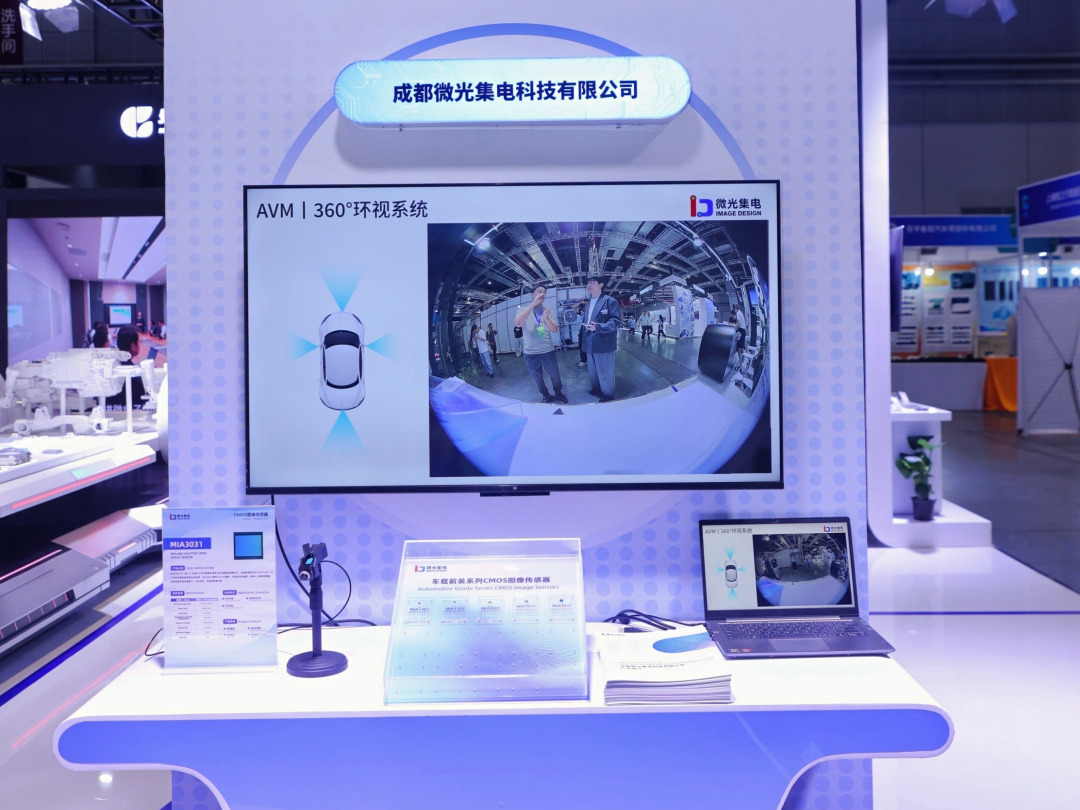
At the exhibition, Image Design highlighted its 3-megapixel automotive-grade CMOS image sensor SoC — the MIA3031. Targeting front-loading AVM (Around View Monitor) applications for vehicles, this product features a 1/2.44-inch optical format and an effective pixel array of 1920×1536, making it suitable for 360° surround-view systems and high-definition reversing cameras.
The MIA3031 adopts DCG+VS exposure technology, achieving a high dynamic range of up to 120 dB. It effectively handles extreme lighting contrast scenarios such as tunnel entrances and exits, and nighttime oncoming headlights, preserving image details in both bright and dark areas within a single to avoid the loss of critical information. The chip also integrates a complete ISP image processing pipeline, encompassing full-chain algorithms including AEC/AWB, 2DNR, DPC, LSC, HDR composition, and image enhancement. This "sensing + processing" two-in-one design eliminates the need for an external standalone ISP, reducing system development complexity and overall cost while shortening the module tuning cycle. In addition, the MIA3031 boasts a sensitivity of up to 11.3 V/lux·s and a signal-to-noise ratio of 44 dB. The high sensitivity enables it to capture more photons under low-light conditions, producing brighter images, while the high SNR effectively suppresses noise, delivering cleaner images with sharper details.
MIA3031
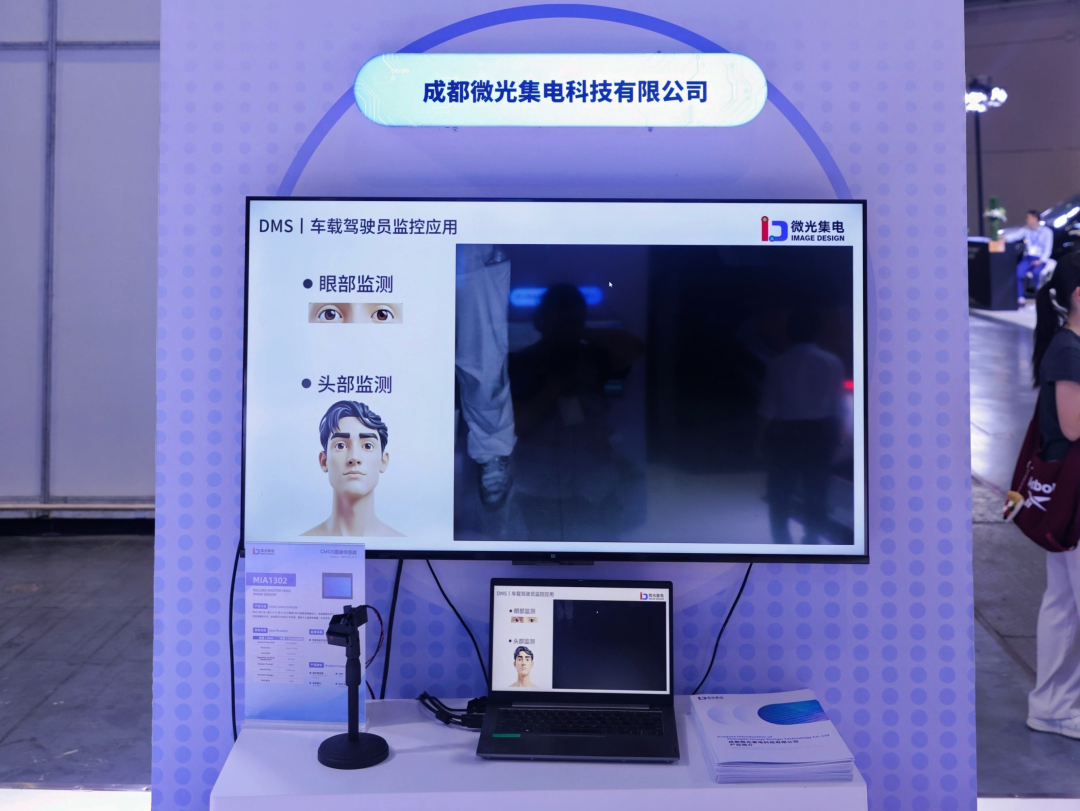
At the same exhibition, the company also showcased another automotive-grade CMOS image sensor — the MIA1302, designed for smart cockpit and driver monitoring system (DMS) applications. It features a 1/3.75-inch optical format and an effective pixel array of 1312×990. The MIA1302 supports high rate output of 90 fps, enabling effective capture of dynamic information such as the driver's head movements, eye movements, and gestures. This reduces the risk of losing critical features due to drops or motion blur, thereby enhancing the recognition stability and response speed of DMS.
In terms of near-infrared (NIR) sensitivity, the MIA1302 achieves sensitivities of 30068 mV·cm²/μW·sec at 850 nm and 12027 mV·cm²/μW·sec at 940 nm, respectively. This allows it to effectively match in-cabin NIR supplemental illumination solutions, maintaining usable image detail under low-light conditions without the need to excessively increase gain or extend exposure time. The MIA1302 offers a dynamic range of 75 dB, covering the wide luminance span inside a vehicle cockpit, from direct sunlight to dim environments. This ensures the integrity of bright and dark details across different lighting conditions and prevents feature loss due to overexposure or underexposure. Its signal-to-noise ratio of 45 dB effectively suppresses readout noise and random noise under low-light or elevated gain conditions, delivering clean and sharp images and ensuring that the extraction accuracy of eye and facial features by backend algorithms remains unaffected by noise.
MIA1302
News
Deepening Technical Exchanges
During the exhibition, Image Design's technical team held technical exchanges with visiting representatives from OEMs and Tier 1 suppliers, engaging in pragmatic discussions on the product performance, automotive-grade certification progress, and application adaptation solutions for the MIA3031 and MIA1302. A number of customers gave positive feedback on the supply stability and technical maturity of the two products in terms of domestic substitution, and expressed their intention to proceed with sample evaluation and project engagement going forward.
The company stated that it will continue to deepen its presence in the automotive front-loading market, advancing product iteration and technological upgrades for application scenarios such as around view, peripheral view, and in-cabin monitoring, thereby contributing to the security, controllability, and independent development of China's automotive industry supply chain.